
What a Good HVAC Website Actually Needs in 2026
Picture this: a homeowner in Kissimmee pulls up their phone on a 95-degree afternoon, types "AC repair near me," and lands on your competitor's website. It loads in under two seconds, the phone number is right at the top, and a banner of glowing five-star reviews seals the deal. They call. You never even knew they were looking.
That's the reality for HVAC companies in the Orlando market right now. And more often than not, the difference between getting that call and missing it has nothing to do with how good your technicians are — it has everything to do with your website.
At Marketivist, we work with local Orlando businesses every day, and we see the same website gaps costing HVAC owners real revenue. So we put together this practical checklist — no jargon, no fluff — of what a good HVAC website actually needs in 2026. Bookmark it, share it with whoever manages your site, and use it to do a fast self-audit.
✅ The HVAC Website Checklist for 2026
1. Mobile Speed That Doesn't Make People Wait
Let's start with the one that disqualifies the most HVAC websites before a homeowner even reads a single word: slow load time on mobile.
Over 70% of HVAC searches happen on a smartphone — and most of them happen in the middle of an inconvenient situation (hot house, broken system, frustrated family). People are not patient. If your site takes more than 3 seconds to load, a significant portion of visitors will hit the back button and call whoever loaded faster.
Google knows this too. Page speed is a direct ranking factor. A slow site doesn't just lose visitors — it loses search position.
Quick test: Run your site through Google PageSpeed Insights. If your mobile score is below 70, it's time to have a serious conversation about your site's foundation.
What to look for:
Images that are properly compressed and sized for mobile
No unnecessary plugins, scripts, or third-party tools bogging down load time
Hosting that doesn't make your site crawl (cheap shared hosting is often the culprit)
A clean, lightweight design that prioritizes speed over visual flash
2. A Phone Number That's Impossible to Miss
This one sounds obvious, but you'd be surprised how many HVAC websites bury the contact info at the bottom of the page — or worse, don't have a clickable phone number at all.
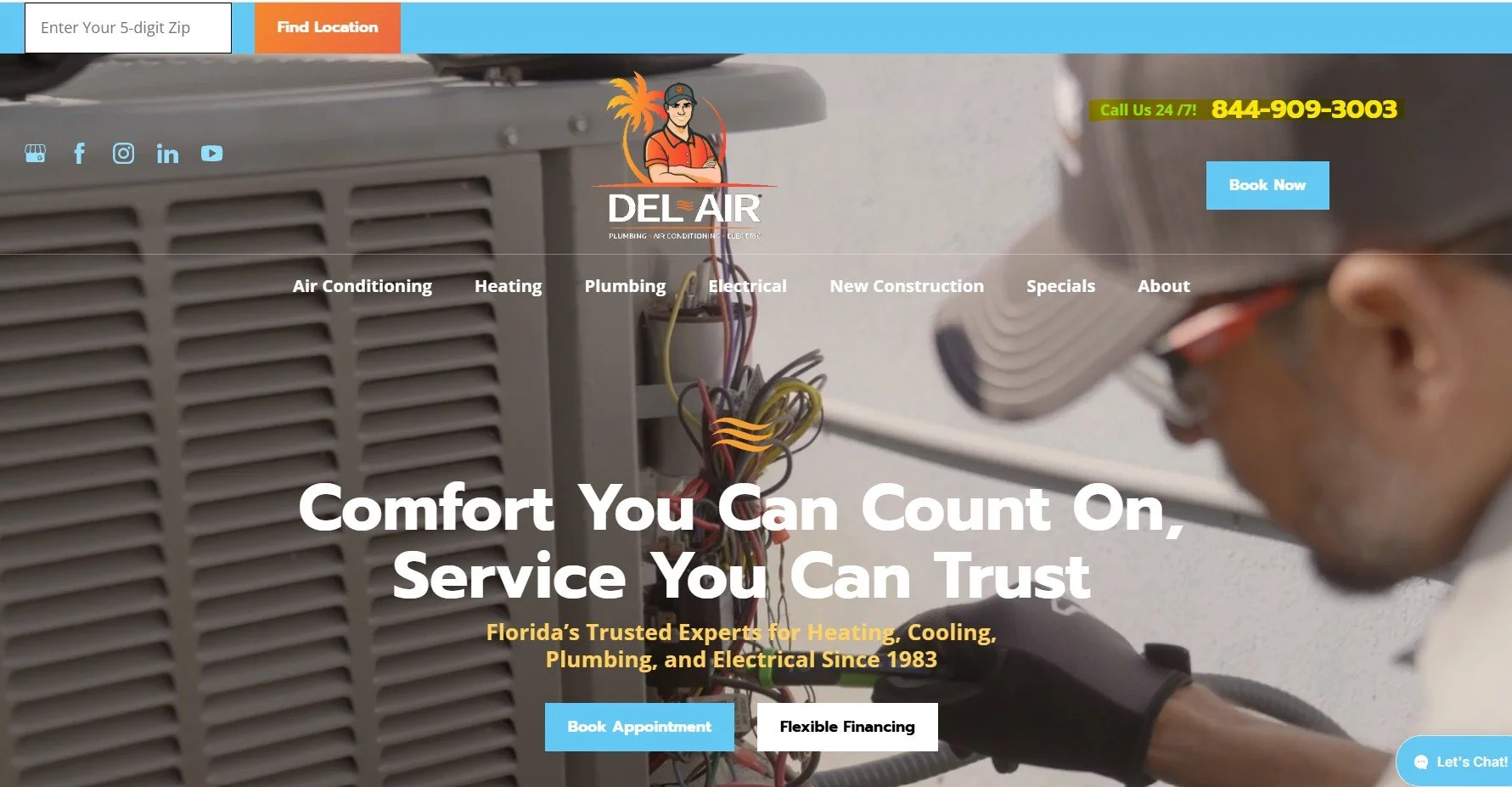
On mobile, a phone number should be a tap away at all times. That means it lives in the header, it's large enough to read without squinting, and clicking it immediately opens the dialer. Every single page.
HVAC is an emergency service. When someone needs you, they need you now. The second they have to search your site for a way to contact you, you've created friction — and friction loses customers.
What to implement:
Sticky header with a clickable phone number visible on scroll
A bold "Call Now" or "Request Service" button above the fold on the homepage
Phone number repeated in the footer for good measure
Bonus: a live chat widget or SMS option for people who'd rather text
Orlando companies doing this well: Del-Air and Pro-Tech Air Conditioning both keep their contact options prominent and frictionless — contributing to why they consistently rank at the top of local searches.
3. Trust Signals That Convert Skeptics
When a homeowner lands on your site, they're asking one question before they even realize it: "Can I trust these people in my house?"
Your website has to answer that question fast. Trust signals are the elements that do that work — and in 2026, homeowners expect to see them upfront.
The trust signals that matter most for HVAC:
Certifications and licenses — NATE-certified? Trane Premier Comfort Specialist? Mitsubishi Diamond Contractor? Display those badges prominently. They tell customers (and Google) that you're a credentialed professional, not a fly-by-night operation.
Years in business — "Serving Orlando since 1998" carries more weight than most HVAC companies realize. Longevity signals reliability.
Manufacturer partnerships — Brand logos from Carrier, Trane, Lennox, or Mitsubishi lend instant credibility.
Photos of your actual team — Real photos of your technicians (in uniform, on the job) build far more trust than stock photos. Homeowners want to know who's showing up at their door.
A/B guarantee or warranty callout — If you offer a satisfaction guarantee or parts warranty, say it loudly and early.
4. A Reviews Widget That Lets Your Customers Sell for You
Online reviews are the single most persuasive content on your HVAC website — and most companies are leaving them on the table by not displaying them prominently on-site.
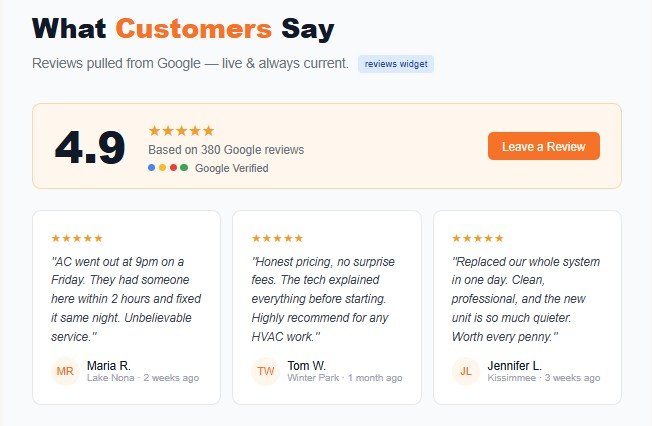
A reviews widget pulls your Google or other platform ratings directly onto your website, showing real, current feedback without requiring visitors to leave your page. It's social proof on autopilot.
Why this matters in 2026: Homeowners are not just reading reviews — they're using review volume and ratings as a shortcut to trust. A company with 200+ Google reviews displayed on their site will win against a company with 15 hidden away on a third-party platform almost every time.
Golden Comfort AC & Heating Repair is one of the strongest examples in the Orlando market. With 344+ Google reviews averaging 5.0 stars, they've turned their review profile into a conversion engine — and bringing that visibility onto their site takes it even further.
What to implement:
Embed a Google Reviews widget on your homepage (tools like Elfsight, EmbedSocial, or Trustindex make this simple)
Display your aggregate star rating and total review count near the top of the page
Feature 3–5 highlighted reviews that mention specific services (AC repair, new installs, emergency service)
Include a visible, easy-to-find link prompting happy customers to leave a review
5. Service Area Pages That Tell Google (and Customers) Where You Work
Here's one of the most overlooked pieces of HVAC website design, and it directly affects how well your site ranks in local search: dedicated pages for every city and neighborhood you serve.
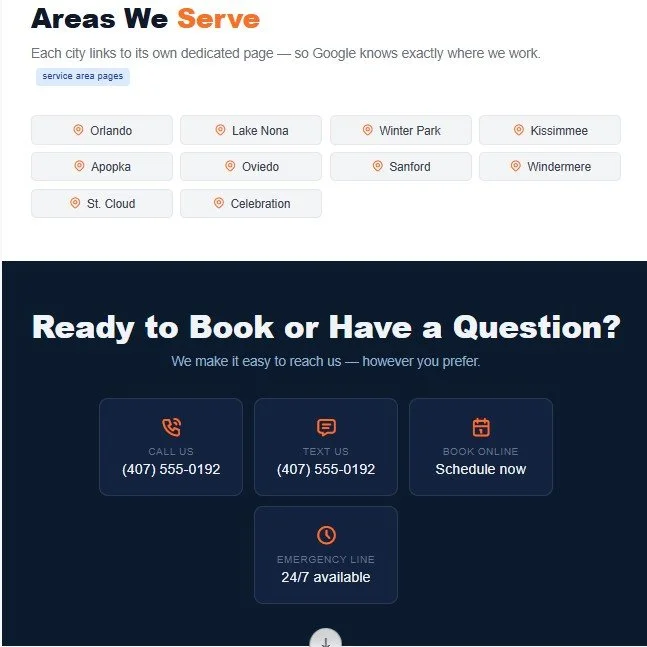
If your website says "Serving the Greater Orlando Area" but doesn't have individual pages for Winter Park, Lake Nona, Kissimmee, Apopka, Oviedo, and the other communities you actually work in — Google has a hard time showing you in searches from those areas. You're leaving hyperlocal traffic on the table every single day.
What a good service area page includes:
The city name in the page title, H1 heading, and body content (naturally, not stuffed)
The specific services you offer in that area
A mention of local landmarks, neighborhoods, or context that signals genuine local relevance
Your contact info and a clear call to action
Del-Air's approach is the gold standard locally — they have dedicated pages for each of their Florida service areas, which is a major contributor to their dominant search presence across multiple markets.
You don't need Del-Air's scale to benefit from this strategy. Even adding 5–6 well-written city pages can meaningfully improve your local rankings within 60–90 days.
Bonus: A Few More Things Worth Checking
If you've got the five essentials above locked in, here are a few other elements that separate a good HVAC website from a great one in 2026:
Online booking or scheduling — More and more homeowners (especially under 40) prefer to book without making a phone call. Even a simple appointment request form removes friction.
Clear service pages for each offering — AC repair, new installs, maintenance plans, duct cleaning, and emergency service should each have their own page, not just a bullet point on a "Services" list.
An FAQ section — Common questions like "How often should I service my AC in Florida?" or "What size unit do I need?" help you rank for informational searches and position you as a knowledgeable resource.
Schema markup — This is behind-the-scenes code that tells Google exactly what type of business you are, what services you offer, and where you're located. It's one of the fastest ways to improve how search engines (and AI tools) understand and recommend your business.
So, How Does Your Site Stack Up?
Run through this checklist and be honest with yourself. If you checked all five boxes, you're in solid shape. If you found a few gaps — that's normal, and more importantly, it's fixable.
The HVAC companies ranking consistently at the top of Orlando search results (Del-Air, Pro-Tech, Golden Comfort, and others) aren't doing anything magic. They've simply made their digital presence a genuine business asset, not an afterthought.
Your website isn't just a brochure — it's your best salesperson. It works 24/7, it reaches customers when they're in their most urgent moment of need, and it either earns their trust or doesn't. In a market as competitive as Central Florida, that matters.
Not sure where your site stands? At Marketivist, we offer a free, no-obligation audit of your HVAC company's digital presence — website, local search visibility, and all. We'll tell you exactly what's working, what isn't, and what would move the needle most. No fluff, no pressure.
Reach us at hello@marketivist.com or schedule a free call at marketivist.com.
Marketivist is an Orlando-based digital marketing agency specializing in SEO, paid search, web development, and local search strategy for small businesses. We work with HVAC companies, home service providers, and local businesses across the Central Florida area.
